<?xml version="1.0" encoding="utf-8"?><feed xmlns="http://www.w3.org/2005/Atom" ><generator uri="https://jekyllrb.com/" version="3.10.0">Jekyll</generator><link href="https://akravasthewise.github.io/feed.xml" rel="self" type="application/atom+xml" /><link href="https://akravasthewise.github.io/" rel="alternate" type="text/html" /><updated>2026-03-30T20:33:10+00:00</updated><id>https://akravasthewise.github.io/feed.xml</id><title type="html">Victor’s menagerie</title><subtitle>A personal blog on science, philosophy and miscellaneous beasts. Open on Sundays.</subtitle><author><name>Victor H. González</name></author><entry><title type="html">Let the Physics Do the Maths companion links</title><link href="https://akravasthewise.github.io/spintronic-IMs/" rel="alternate" type="text/html" title="Let the Physics Do the Maths companion links" /><published>2026-03-30T00:00:00+00:00</published><updated>2026-03-30T00:00:00+00:00</updated><id>https://akravasthewise.github.io/spintronic-IMs</id><content type="html" xml:base="https://akravasthewise.github.io/spintronic-IMs/"><![CDATA[<p>Thank you for attending my talk. You can access links for the articles in my presentation by clicking on the titles below. Each section also contains bite-sized descriptions of what we achieved in each paper. If you would like to discuss further, you can approach me during the conference, email me at: <a href="mailto:vhg23@cam.ac.uk" target="_blank" rel="noopener">vhg23.cam.ac.uk</a> or connect with me on <a href="https://www.linkedin.com/in/victor-h-gonz%C3%A1lez-129023a1/" target="_blank" rel="noopener">LinkedIn</a>.</p>

<h2 id="spintronic-devices-as-next-generation-computation-accelerators"><a href="https://doi.org/10.1016/j.cossms.2024.101173" target="_blank" rel="noopener">Spintronic devices as next-generation computation accelerators</a></h2>

<p><img src="../assets/images/GD.png" alt="Gradient descent in an Ising machine" /></p>

<p>This paper was the basis for the talk, and it is an opinionated review of the current and future directions of spintronic platforms. We propose the distinction of spatially-resolved and time-multiplexed Ising machines, and discuss the differences between the two architectures. We also analyse critical aspects of network control and operational constraints of current systems with the intent of promoting interdisciplinary collaboration and hardware-algorithm co-design.</p>

<p>Finally, we benchmark spintronic IMs against non-magnetic software and hardware platforms. This is a pedagogical paper written for a general condensed matter audience and a good starting point if you wish to .</p>

<h2 id="voltage-control-of-frequency-effective-damping-and-threshold-current-in-nano-constriction-based-spin-hall-nano-oscillators"><a href="https://doi.org/10.1063/5.0128786" target="_blank" rel="noopener">Voltage control of frequency, effective damping, and threshold current in nano-constriction-based spin Hall nano-oscillators</a></h2>

<p>This paper is a computational study of the effect of voltage-controlled magnetic anisotropy (VCMA) over the dynamics of spin Hall nano-oscillators (SHNOs). The geometry of constriction-based SHNOs leads to localization of the induced magnetization precession and thus enabling localized control via voltage. SHNO-based IMs require individual control and VCMA is a good candidate for large scale realization, enabling tunning of the oscillation parameters.</p>

<p><img src="../assets/images/gated_shnos.png" alt="Voltage-gated SHNO" /></p>

<p>Wave propagation in magnetic media is a fascinating phenomenon with surprising results, such as radiative damping and sigmoid-shaped current thresholds. VCMA has shown much versatility as a mechanism to control the medium itself and thus engineer magnon propagation in individual oscillators.</p>

<h2 id="spin-wave-mediated-mutual-synchronization-and-phase-tuning-in-spin-hall-nano-oscillators"><a href="https://www.nature.com/articles/s41567-024-02728-1" target="_blank" rel="noopener">Spin-wave-mediated mutual synchronization and phase tuning in spin Hall nano-oscillators</a></h2>

<p>This paper is an excellent experimental demonstration of the potential of propagating spin waves for coupling arrays of SHNOs. Electrically, we measure in-phase and anti-phase synchronization regimes, and show that the physics of propagating spin waves drives the dissipative coupling responsible for both types of synchronization. To discard oscillation death as a cause, we observe the magneto-active areas directly using $\micro$BLS and show that the phase of the SHNOs is indeed binarized.</p>

<p><img src="../assets/images/425_vs_500.gif" alt="Phase and anti-phase SHNOs" /></p>

<p>We complement these measurements with computational simulations and find that, once again, VCMA can be used to modify the propagation of the spin waves and switch between in-phase and anti-phase synchronization. These results show that pairwise coupling can be effectively tuned via VCMA, charting a path for larger SHNO-based IMs.</p>

<h2 id="a-numerical-model-for-time-multiplexed-ising-machines-based-on-delay-line-oscillators"><a href="https://doi.org/10.48550/arXiv.2406.07197" target="_blank" rel="noopener">A numerical model for time-multiplexed Ising machines based on delay-line oscillators</a></h2>

<p>We proposed this mathematical model in order to understand the dynamics of delay-line time-multiplexed IMs better. Based on the nonlinear coefficients present in real IMs, we were able to simulate the operation of time-multiplexed IMs on quadratic problems of different complexity and found that this type of machines operate better at the edge of synchronization. We argue that this is because the generalized force felt by the oscillators is approximately zero and allows the machine to avoid spurious local minima.</p>

<p>We link these nonlinearities with actual properties of electrical circuits, and propose effective ways of tuning these types of IMs.</p>

<h2 id="a-spinwave-ising-machine"><a href="https://www.nature.com/articles/s42005-023-01348-0#Abs1" target="_blank" rel="noopener">A spinwave Ising machine</a></h2>

<p>This is the demonstration of the world’s first spinwave Ising machine (SWIM), a time-multiplexed IM that uses spin wave packets propagating in a YIG delay line to construct the artificial spin state. Using phase sensitive amplification, we binarize the phase of the oscillators and induce analogue negative coupling using an additional delay element. We show that the 4 and 8 artificial spins in a chain change their phase to reach the antiparallel ground state.</p>

<p><img src="../assets/images/swim-graph.png" alt="SWIM" /></p>

<p>This realization shows the potential of magnonic films as memory elements for IMs and paves the way for delay line engineering as an alternative for exciting larger numbers of oscillators in SWIMs.</p>

<h2 id="global-biasing-using-a-hardware-based-artificial-zeeman-term-in-spinwave-ising-machines"><a href="https://doi.org/10.1063/5.0185888" target="_blank" rel="noopener">Global biasing using a hardware-based artificial Zeeman term in spinwave Ising machines</a></h2>

<p>Once we had the SWIM, we wanted to embed graphs with higher complexity using analogue means. Since it has been shown that a 2D Ising model with an global bias is <a href="https://iopscience.iop.org/article/10.1088/0305-4470/15/10/028">NP-complete</a>, we expanded the limits of our machine by adding such bias in the form of an additional RF source at the same frequency as the spins. The phase of this source allows us to favour either in-phase or anti-phase synchronization and transition between parallel and antiparallel alignments despite constant negative coupling, similar to an antiferromagnet in a strong magnetic field.</p>

<p><img src="../assets/images/ferrimagnetic_ordering.png" alt="Ferrimagnetic ordering in SWIM" /></p>

<p>By changing the amplitude of the bias signal, we were able to observe a partially aligned phase (similar to a ferrimagnet). We noticed that this “ferrimagnetic” phase was caused by a spin amplitude mismatch. If one of the spins is shorter that the others, it is more energetically favourable to partially align the others with the external field. We also observed signs of phase frustration for an odd number of oscillators, suggesting paths of development for Potts machines (IMs with more than two phases).</p>]]></content><author><name>Victor H. González</name></author><summary type="html"><![CDATA[Thank you for attending my talk. You can access links for the articles in my presentation by clicking on the titles below. Each section also contains bite-sized descriptions of what we achieved in each paper. If you would like to discuss further, you can approach me during the conference, email me at: vhg23.cam.ac.uk or connect with me on LinkedIn. Spintronic devices as next-generation computation accelerators This paper was the basis for the talk, and it is an opinionated review of the current and future directions of spintronic platforms. We propose the distinction of spatially-resolved and time-multiplexed Ising machines, and discuss the differences between the two architectures. We also analyse critical aspects of network control and operational constraints of current systems with the intent of promoting interdisciplinary collaboration and hardware-algorithm co-design. Finally, we benchmark spintronic IMs against non-magnetic software and hardware platforms. This is a pedagogical paper written for a general condensed matter audience and a good starting point if you wish to . Voltage control of frequency, effective damping, and threshold current in nano-constriction-based spin Hall nano-oscillators This paper is a computational study of the effect of voltage-controlled magnetic anisotropy (VCMA) over the dynamics of spin Hall nano-oscillators (SHNOs). The geometry of constriction-based SHNOs leads to localization of the induced magnetization precession and thus enabling localized control via voltage. SHNO-based IMs require individual control and VCMA is a good candidate for large scale realization, enabling tunning of the oscillation parameters. Wave propagation in magnetic media is a fascinating phenomenon with surprising results, such as radiative damping and sigmoid-shaped current thresholds. VCMA has shown much versatility as a mechanism to control the medium itself and thus engineer magnon propagation in individual oscillators. Spin-wave-mediated mutual synchronization and phase tuning in spin Hall nano-oscillators This paper is an excellent experimental demonstration of the potential of propagating spin waves for coupling arrays of SHNOs. Electrically, we measure in-phase and anti-phase synchronization regimes, and show that the physics of propagating spin waves drives the dissipative coupling responsible for both types of synchronization. To discard oscillation death as a cause, we observe the magneto-active areas directly using $\micro$BLS and show that the phase of the SHNOs is indeed binarized. We complement these measurements with computational simulations and find that, once again, VCMA can be used to modify the propagation of the spin waves and switch between in-phase and anti-phase synchronization. These results show that pairwise coupling can be effectively tuned via VCMA, charting a path for larger SHNO-based IMs. A numerical model for time-multiplexed Ising machines based on delay-line oscillators We proposed this mathematical model in order to understand the dynamics of delay-line time-multiplexed IMs better. Based on the nonlinear coefficients present in real IMs, we were able to simulate the operation of time-multiplexed IMs on quadratic problems of different complexity and found that this type of machines operate better at the edge of synchronization. We argue that this is because the generalized force felt by the oscillators is approximately zero and allows the machine to avoid spurious local minima. We link these nonlinearities with actual properties of electrical circuits, and propose effective ways of tuning these types of IMs. A spinwave Ising machine This is the demonstration of the world’s first spinwave Ising machine (SWIM), a time-multiplexed IM that uses spin wave packets propagating in a YIG delay line to construct the artificial spin state. Using phase sensitive amplification, we binarize the phase of the oscillators and induce analogue negative coupling using an additional delay element. We show that the 4 and 8 artificial spins in a chain change their phase to reach the antiparallel ground state. This realization shows the potential of magnonic films as memory elements for IMs and paves the way for delay line engineering as an alternative for exciting larger numbers of oscillators in SWIMs. Global biasing using a hardware-based artificial Zeeman term in spinwave Ising machines Once we had the SWIM, we wanted to embed graphs with higher complexity using analogue means. Since it has been shown that a 2D Ising model with an global bias is NP-complete, we expanded the limits of our machine by adding such bias in the form of an additional RF source at the same frequency as the spins. The phase of this source allows us to favour either in-phase or anti-phase synchronization and transition between parallel and antiparallel alignments despite constant negative coupling, similar to an antiferromagnet in a strong magnetic field. By changing the amplitude of the bias signal, we were able to observe a partially aligned phase (similar to a ferrimagnet). We noticed that this “ferrimagnetic” phase was caused by a spin amplitude mismatch. If one of the spins is shorter that the others, it is more energetically favourable to partially align the others with the external field. We also observed signs of phase frustration for an odd number of oscillators, suggesting paths of development for Potts machines (IMs with more than two phases).]]></summary></entry><entry><title type="html">A transitional view of unconventional computing</title><link href="https://akravasthewise.github.io/transitional-unconventional-computing/" rel="alternate" type="text/html" title="A transitional view of unconventional computing" /><published>2026-03-06T00:00:00+00:00</published><updated>2026-03-06T00:00:00+00:00</updated><id>https://akravasthewise.github.io/transitional-unconventional-computing</id><content type="html" xml:base="https://akravasthewise.github.io/transitional-unconventional-computing/"><![CDATA[<p>Interesting problems lie at transitions. In complex systems such as the climate, the stock market, the power grid and artificial neural networks, understanding of their stability, disorder and transitions has fueled incredible intellectual and societal progress. The ability to make predictions over complex systems using has allowed us both to understand the natural world, and to create trust in complicated structures with thousands (or even millions) of moving parts. So, it was without hesitation that I took the opportunity to work on such systems and went through a transition of my own.</p>

<p>It has been three months since I arrived at the University of Cambridge to join Prof. Natalia Berloff’s group, and I can say that I am excited by the directions of our work within the Heisingberg consortium and beyond. Even though I work for the Faculty of Mathematics now, my background is in computational physics. In my PhD dissertation, we constructed and analysed Ising machines using nanoscopic magnetic oscillators; so my new post might look like a small professional transition. But learning about the mathematical properties behind the evolution of these systems and the theory of spin glasses has opened my horizon to the myriad of open questions that still remain after decades of study into complex systems. Furthermore, mathematics can provide insight and guide further progress into a class of Ising machines that has reshaped our current economic and societal landscapes: artificial neural networks (ANNs).</p>

<p>As Professors Berloff and Laussy have discussed in a <a href="https://www.heisingberg.eu/2024/11/18/the-ising-machine-that-thinks/">post</a> in the Heisingberg blog, the intrinsic relation between Ising machines and ANNs emerged from John Hopfield’s interest and knowledge of spin glasses when he posed the question: Can an Ising model be trained to perform a useful function? It turns out, it can; and Hopfield, together with Geoffrey Hinton, laid the groundwork for the current machine learning Golden Age where ANNs have been applied to problems as complex as text synthesis and generation, medical drug discovery and genetic sequencing. It is clear that ANNs are here to stay. What it is yet to be established are the limitations and sustainability of the current computational paradigms and a big question: why do ANNs work?</p>

<p>The answer to this question is brief but complex: feedforward ANNs are <a href="https://doi.org/10.1007%2FBF02551274">Universal Function Approximators</a>. Simply, given a number of observations (or measurements), the network evolves, independent of a human operator, into a functional form that can approximate the underlying statistical distribution of the observations to an arbitrary degree; effectively modelling the behavior described by the observations. The end goal for many use cases of applied mathematics (like weather forecasting or data classification) is to model such distributions in order to make predictions with a high degree of confidence; so it’s not a surprise that they have been readily adopted by an ever growing industrial machine learning (ML) community.</p>

<p>Deep neural networks (DNNs) are the most successful of these approximators, though at a steep computational cost, with most state-of-the-art applications requiring wider and deeper networks (at the time of writing, Large Language Models’ underlying networks are on the numbers of trillions). And though it is well understood what happens to ANNs at an individual neuron level, a detailed understanding of large networks is not very practical and short of impossible for modern models. This is where the tools of statistical physics come in handy.</p>

<p>Statistical physics is a mathematical framework developed to study enormous emsembles of physical units as collective systems rather than considering the individual behavior of each unit. Thermodynamical models are the prototypical example of such emsembles: though we understand molecular and atomic collisions reasonably well, we use temperature rather than atomic momenta to characterize and make predictions about a volume of gas. Using a statistical rather than a exact description for all particles helps to understand the dynamics of the ensemble as a whole.</p>

<p>Similarly, statistical descriptions of neural networks have helped to understand how they work and come up with better ways to both train them and utilize available computational resources. The transition from micro to macro has brought both greater understanding of ANNs and DNNs and possible paths for improving them. By contrast to the progress made so far in ML through clever engineering and empirical discovery, the framework of statistical physics can be used to systematize these improvements and offer insights into possible future directions.</p>

<p>A current issue in need of insight is the scaling problem in LLMs: designing and training expontentially larger networks has shown diminishing returns in accuracy. Even Yann LeCun (the “Godfather of AI”), has stated that <a href="https://www.businessinsider.com/meta-yann-lecun-scaling-ai-wont-make-it-smarter-2025-4?op=1">larger is not better</a>, as the reasoning ability of DNN-based text chatbots does not appear to scale with the financial and environmental assets poured into their construction. For example, the ML industry has led to <a href="https://www.bloomberg.com/graphics/2025-ai-data-centers-electricity-prices/">rises in electricity prices</a>, <a href="https://www.cnbc.com/2026/01/10/micron-ai-memory-shortage-hbm-nvidia-samsung.html">global GPU and RAM shortages</a>, and <a href="https://sustainableict.blog.gov.uk/2025/09/17/ais-thirst-for-water/">overconsumption and pollution of water sources</a>. For all of these reasons, scaling DNNs do not seem to be a long-term and logically sound strategy to produce industrial and consumer-grade tools, opening the floor for alternative computation architectures, such as those developed by the Heisingberg consortium.</p>

<p>Despite their ubiquity, the rise of DNNs was anything but assured. Although the foundations of “learning matrices” were established as far back as sixty years ago, the breakthrough of using graphical processing units (meant for rendering videogames and animations) for the matrix mutiplication operations necessary for training deep neural networks (DNNs) only came about in the early 2000s. The subsequent bonanza on the application of DNNs to practical mathematical and statistical problems thus relied heavily on a sort of <a href="https://doi.org/10.1145/3467017">hardware lottery</a> that promoted algorithms reliant on matrix multiplication and relegated other forms algorithms as unfeasible mathematical curiosities.</p>

<p>However, similarly to how expert systems were quickly displaced by neural networks by an unplanned convergence between hardware and software, not matrix-multiplication-based learning schemes might provide scaling advantages over DNNs if they are implemented into specialized hardware. Namely, CPU-bound learning is limited by the so-called von Neumman bottleneck introduced by the serialized movement of data between memory and processor. If the calculations could be done in parallel in the memory itself, that would translate to cheaper, faster and leaner computation, incentivizing research and commercialization of alternative learning architectures.</p>

<p>The Heisingberg project’s Ising machine hardware and algorithms are great examples of analogue in-memory computers designed to realize the potential held by a transition from conventional to unconventional computing. At its crux, physics-based computing has the potential to deliver energy-efficient hardware-based computation accelerators purpose-built to realize these alternative learning architectures</p>

<p>Questions abound and the lively discussions with our partners always present me with a fractally complex landscape of what is possible in these systems, which I could not imagine when I picked this niche topic as the central theme of my PhD dissertation. This intersection between nonlinear systems, applied mathematics and statistical physics has compelling open questions with real-world applications, so I am excited to see the collective changes that say that my transition from computational physicist to applied mathematician brings outside of my own neural network reorganization.</p>

<p><img src="../assets/images/network_and_free_energy.gif" alt="Equivalence between network transitions and energy minimization" /></p>

<p><em>A network transition (left) can be thought of as an energy minimization (right) of tbe free energy of the system. We study such mechanisms in the Heisingberg consortium.</em></p>

<p><strong>This post originally appeared in the Heisingberg consortium’s <a href="https://www.heisingberg.eu/2026/02/24/a-transitional-view-of-unconventional-computing/">blog</a>.</strong> Check it out for more news and essays in cutting-edge Ising machine research.</p>]]></content><author><name>Victor H. González</name></author><summary type="html"><![CDATA[Interesting problems lie at transitions. In complex systems such as the climate, the stock market, the power grid and artificial neural networks, understanding of their stability, disorder and transitions has fueled incredible intellectual and societal progress. The ability to make predictions over complex systems using has allowed us both to understand the natural world, and to create trust in complicated structures with thousands (or even millions) of moving parts. So, it was without hesitation that I took the opportunity to work on such systems and went through a transition of my own.]]></summary></entry><entry><title type="html">My thesis has been published and defended!</title><link href="https://akravasthewise.github.io/phd-thesis/" rel="alternate" type="text/html" title="My thesis has been published and defended!" /><published>2025-04-25T00:00:00+00:00</published><updated>2025-04-25T00:00:00+00:00</updated><id>https://akravasthewise.github.io/phd-thesis</id><content type="html" xml:base="https://akravasthewise.github.io/phd-thesis/"><![CDATA[<p><strong>In my thesis, I explored the construction of microscopic complex networks of oscillators which communicate with each other using magnetic waves. These networks have a wide range of cutting-edge industry-relevant applications, from making AI training more energy-efficient to offering a low-cost alternative to quantum computers.</strong></p>

<p>Spintronics, short for spin electronics, is a branch of condensed matter physics that aims to control a quantum property of electrons called spin to build fast, small and low power electronic devices. Since spins are the source of magnetism in materials, spintronics leverages the properties and geometry of magnetic materials to build tiny oscillators, roughly the size of a one thousandth of a human hair, which communicate with each other using magnetic waves. Due to their physical properties, a network of these oscillators can operate at very high frequencies and consume less power than one constructed using conventional electronics.</p>

<figure>
    <img src="../assets/images/thesis-cover.png" alt="Gradient descent and two types of spintronic oscillators" />
    <figcaption>The gradient descent algorithm (top) is performed when the magnetic waves present in YIG delay line (left) or a spin Hall nano-oscillator (left) evolve according to the laws of physics, and without the need of a programming language.</figcaption>
</figure>

<p>Controlling the communication between the oscillators in the network allows the entire system to be programmed in a computing architecture known as an Ising machine (IM) which performs an analog computing algorithm called gradient descent. This algorithm calculates approximate solutions for computationally hard problems (such as optimizing a stock portfolio or finding new organic molecules for medication) in a similar fashion to the neural networks present in modern AI algorithms. What makes the research stand out, is that the spintronic IM does not require an operating system or a programming language, but rather the answer is calculated as the system follows the laws of physics. This physical computation greatly reduces the overhead of the computing architectures and can produce approximate solutions very quickly in a tiny device with low energetic cost. Spintronic oscillator networks can thus pave the way for sustainable AI training, enable edge computing hardware and greatly reduce the material costs for optimization in many industries ranging from biomedical research to quantitative finance. This work shows how cutting-edge magnetic materials research can be the starting point for the construction of next-generation of hardware-based computing accelerators.</p>

<p>If you’d like to read my thesis, I can send you a physical copy (I have over 60) or you can download it from the University of Gothenburg’s library <a href="https://gupea.ub.gu.se/handle/2077/85522" target="_blank">website</a>.</p>]]></content><author><name>Victor H. González</name></author><summary type="html"><![CDATA[In my thesis, I explored the construction of microscopic complex networks of oscillators which communicate with each other using magnetic waves. These networks have a wide range of cutting-edge industry-relevant applications, from making AI training more energy-efficient to offering a low-cost alternative to quantum computers.]]></summary></entry><entry><title type="html">Paper summary: Spin-wave-mediated mutual synchronization and phase tuning in spin Hall nano-oscillators</title><link href="https://akravasthewise.github.io/spin-wave-mediated-shnos/" rel="alternate" type="text/html" title="Paper summary: Spin-wave-mediated mutual synchronization and phase tuning in spin Hall nano-oscillators" /><published>2025-01-08T00:00:00+00:00</published><updated>2025-01-08T00:00:00+00:00</updated><id>https://akravasthewise.github.io/spin-wave-mediated-shnos</id><content type="html" xml:base="https://akravasthewise.github.io/spin-wave-mediated-shnos/"><![CDATA[<p>From the coordinated flash of fireflies to the intricate network of GPS satellites that guide us, synchronization is everything. Getting independent parts to work together in perfect rhythm is a fundamental challenge in nature and technology. In the Applied Spintronics Group, we are working on mastering this challenge at an impossibly small scale to build the foundation for a new generation of computers.</p>

<p>Our work deals with “spintronics,” a field of physics that seeks to use a quantum property of electrons called “spin.” You can think of spin as an electron’s own tiny, internal magnet. Instead of pushing electrons through wires to create an electrical current—which generates heat and consumes energy—we want to send information by creating and controlling ripples of magnetism, known as “spin waves.” This could lead to computers that are not only faster but vastly more energy-efficient than the devices we use today.</p>

<p>To create these spin waves, we build microscopic devices called spin Hall nano-oscillators. The challenge is that for these oscillators to be useful, they can’t just operate on their own; they need to be synchronized and work as a team.</p>

<p>In our recent discovery, we found a way to do just that. We took two of these tiny magnetic oscillators, placed them incredibly close to each other, and found that the spin waves they produce act as a form of communication, allowing them to naturally fall into a synchronized rhythm.</p>

<p>But we discovered something even more exciting: we can control the <em>nature</em> of their synchronized dance. By carefully adjusting the electrical current we apply, we can flip a switch between two distinct states:</p>

<ol>
  <li><strong>In-Phase:</strong> The two oscillators move in perfect unison, like two swimmers doing a synchronized stroke. Their combined signal is strong and clear.</li>
  <li><strong>Anti-Phase:</strong> The oscillators move in perfect opposition. When one zigs, the other zags. In this state, their individual signals effectively cancel each other out, and the combined signal nearly vanishes.</li>
</ol>

<p>This ability to switch between a strong “on” state and a nearly “off” state is a critical breakthrough. To be absolutely sure that the oscillators were still working in the “off” state, we used highly advanced microscopy to look at them directly. We confirmed that they were indeed still oscillating with full force, just in a way that made their combined output invisible. Our computer simulations of the process also perfectly matched what we saw in the lab.</p>

<p>The ability to control the phase of synchronization is a fundamental building block for future computing. It gives us a new type of switch, which could be used to represent the 1s and 0s of digital logic or to create devices that mimic the way neurons interact in the human brain. This work shows a clear path forward for creating complex, powerful, and remarkably efficient computer systems based on the subtle dance of magnetism.</p>

<hr />

<h3 id="whats-next">What’s Next?</h3>

<p>This research opens a new chapter in designing computing hardware at the nanoscale. We’ve shown it’s possible to control these tiny oscillators, and the next step is to scale up, building larger networks that can tackle real-world computational problems.</p>

<p>If you’re interested in the technical details behind this discovery, you can read our full paper, it’s open access and can be found at this link: <a href="https://www.nature.com/articles/s41567-024-02728-1" target="_blank"><em>Spin-wave-mediated mutual synchronization and phase tuning in spin Hall nano-oscillators</em></a>. We welcome your questions and thoughts in the comments below!
&lt;&gt;
***</p>

<p><em>Disclaimer: This summary was generated with the assistance of an AI. The text has been reviewed and edited by me.</em></p>]]></content><author><name>Victor H. González</name></author><summary type="html"><![CDATA[From the coordinated flash of fireflies to the intricate network of GPS satellites that guide us, synchronization is everything. Getting independent parts to work together in perfect rhythm is a fundamental challenge in nature and technology. In the Applied Spintronics Group, we are working on mastering this challenge at an impossibly small scale to build the foundation for a new generation of computers.]]></summary></entry><entry><title type="html">The IPT is looking for phycisists</title><link href="https://akravasthewise.github.io/IPT-recruiting-23/" rel="alternate" type="text/html" title="The IPT is looking for phycisists" /><published>2024-09-15T00:00:00+00:00</published><updated>2024-09-15T00:00:00+00:00</updated><id>https://akravasthewise.github.io/IPT-recruiting-23</id><content type="html" xml:base="https://akravasthewise.github.io/IPT-recruiting-23/"><![CDATA[<h2 id="lunch-seminar"><strong>Lunch seminar</strong></h2>
<p>We will have a lunch seminar on September 23rd at 11:50 in room FB of building Fysik Örigo. We will give a presentation on the tournament, the associated course and answer any questions you might have.</p>

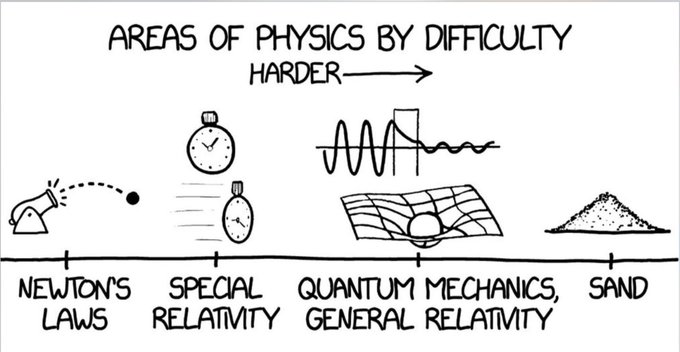
<p><img src="../assets/images/physics-hardness-meme.jpg" alt="What they never tell you during undergrad" /></p>

<p>Have you ever wondered how physical models are created? Why are equations formulated the way they are? What do these relationships reveal about everyday phenomena? If these questions intrigue you, the IPT is just for you!</p>
<h1 id="what-is-the-ipt">What is the IPT?</h1>
<p>The International Physicists’ Tournament, or IPT for short, is a global competition for physics and engineering students. It seeks to hone theoretical and experimental analytical skills through the exploration of 17 open-ended problems. Over a span of six months, participants will design, build, test, and analyze the systems proposed in these challenges, culminating in a presentation at Warsaw, Poland the following spring.</p>

<p>IPT’s problems are framed to be easily comprehensible, yet they demand creativity and a robust grasp of physics for resolution. An added perk? You earn credits that can be applied toward your engineering physics or physics degree. Check out our syllabus <a href="../assets/IPT_course_syllabus.pdf">right here</a>.</p>

<iframe width="560" height="315" src="https://www.youtube.com/embed/kD28edrq_dY?si=GdP843nQ9DkJ6LVp" title="YouTube video player" frameborder="0" allow="accelerometer; autoplay; clipboard-write; encrypted-media; gyroscope; picture-in-picture; web-share" referrerpolicy="strict-origin-when-cross-origin" allowfullscreen=""></iframe>

<h2 id="a-sample-ipt-problem">A sample IPT problem</h2>
<p><strong>Kelvin Dropper</strong></p>

<p>A reservoir containing a conducting liquid is connected to two hoses that release two falling streams of drops, which land in two containers. Each stream passes through a metal ring or open cylinder which is electrically connected to the opposite receiving container. After a while, a spark may be observed between two conducting rods connected to the setup. Use this setup as an electrical generator. Investigate and optimize its power efficiency.</p>

<iframe width="560" height="315" src="https://www.youtube.com/embed/rv4MjaF_wow?si=JBluPDYosJk3Kub7" title="YouTube video player" frameborder="0" allow="accelerometer; autoplay; clipboard-write; encrypted-media; gyroscope; picture-in-picture; web-share" referrerpolicy="strict-origin-when-cross-origin" allowfullscreen=""></iframe>

<h1 id="what-do-i-need-to-know">What do I need to know?</h1>

<p>As a general requirement, you should be a bachelors or masters student at Chalmers or GU accepted to a physics or engineering program. That said, feel free to apply if you are enthusiastic about the tournament and think you can bring another perspective to the table.</p>

<p>No specific seniority or prior experience is mandated—you’ll gain ample knowledge as you delve deep into the problems. If physics excites you and you’re keen on acquainting yourself with the methodologies and cognitive processes characteristic of scientists, I’m here to guide you through any required concepts.</p>

<h1 id="how-do-i-apply">How do I apply?</h1>

<p>In order to apply, you must send me a short pre-study report on one of the problems of the <a href="https://iptnet.info/problems/">IPT problem list</a>. You can choose among the following problems:</p>

<div class="language-plaintext highlighter-rouge"><div class="highlight"><pre class="highlight"><code>4. Traveling Flame  
6. An Optimal Candle
10. Rotating Ring
11. Soft Rescuer
14. Loud Bicycle 
</code></pre></div></div>

<p>In your report, outline your initial reactions to the problem. Pose these questions: How would you go about it? Are there relevant equations or principles to consider? Can you conceive an experimental setup to systematically change the variables of the phenomenon??</p>

<p><strong>Deadline:</strong> The report must be written in english and <a href="mailto:victor.gonzalez@physics.gu.se">emailed to me</a> in pdf format by <strong>Wednesday October 2nd at 23:59</strong></p>]]></content><author><name>Victor H. González</name></author><summary type="html"><![CDATA[Lunch seminar We will have a lunch seminar on September 23rd at 11:50 in room FB of building Fysik Örigo. We will give a presentation on the tournament, the associated course and answer any questions you might have.]]></summary></entry><entry><title type="html">Paper summary: Spintronic devices as next-generation computation accelerators</title><link href="https://akravasthewise.github.io/spintronics-IMs/" rel="alternate" type="text/html" title="Paper summary: Spintronic devices as next-generation computation accelerators" /><published>2024-06-25T00:00:00+00:00</published><updated>2024-06-25T00:00:00+00:00</updated><id>https://akravasthewise.github.io/spintronics-IMs</id><content type="html" xml:base="https://akravasthewise.github.io/spintronics-IMs/"><![CDATA[<p>In this blog post, I’d like to walk you through the key points of our recent review article titled <strong>“Spintronic devices as next-generation computation accelerators.”</strong> This paper delves into the growing field of spintronics and its potential to revolutionize how we approach computational challenges, particularly through <strong>Ising machines</strong> and <strong>neuromorphic computing</strong>. With silicon-based technologies nearing their limits, spintronics offers an exciting alternative that could pave the way for more energy-efficient, scalable, and powerful computing systems.</p>

<p>Today’s computers, while impressive, face limitations. They consume a lot of power and are becoming increasingly difficult to miniaturize. This is where “spintronics” emerges as a promising alternative! Spintronics utilizes a fascinating principle of physics to enhance the speed and efficiency of computers. It involves harnessing the “spin” of electrons, akin to a minuscule spinning top within them.</p>

<h3 id="what-are-ising-machines">What are Ising Machines?</h3>

<p>Imagine a complex puzzle with numerous possible solutions. Ising machines are specialized computers designed to solve these puzzles rapidly. They employ a physics concept known as the “Ising model,” which guides them in discovering the optimal solution among a vast number of possibilities. And here’s the exciting part: spintronics can be used to construct these remarkable Ising machines!</p>

<h3 id="spintronic-ising-machines">Spintronic Ising Machines:</h3>

<p>Spintronic Ising machines come in a few different types:</p>

<ul>
  <li><strong>Oscillator-based:</strong> These machines utilize tiny electronic components that generate waves to represent the puzzle pieces and their connections.</li>
  <li><strong>Probabilistic:</strong> These machines employ “magnetic tunnel junctions” to test different solutions randomly until the best one is found. It’s like flipping a coin, but with a much higher level of intelligence!</li>
  <li><strong>Spin-wave based:</strong> These machines use waves in magnetic materials to represent the puzzle, similar to ripples in water.</li>
</ul>

<p>Each type possesses unique strengths, but they all share the fundamental advantages of spintronics: exceptional speed, low power consumption, and the potential for extreme miniaturization.</p>

<h3 id="benchmarking-and-comparison">Benchmarking and Comparison</h3>

<p>How do these spintronic Ising machines measure up? We can assess them based on several factors:</p>

<ul>
  <li><strong>Speed:</strong> How quickly they can find the solution.</li>
  <li><strong>Energy efficiency:</strong> The amount of power they consume.</li>
  <li><strong>Scalability:</strong> The number of puzzle pieces they can handle.</li>
  <li><strong>Stability:</strong> Their level of reliability.</li>
</ul>

<p>In comparison to other technologies, spintronics demonstrates significant advantages. It can surpass traditional computers in terms of speed and energy efficiency, and it even has the potential to outperform advanced computing technologies like quantum annealers.</p>

<h3 id="future-outlook">Future Outlook</h3>

<p>So, what are the potential applications of these spintronic Ising machines? They hold the key to revolutionizing various fields, including:</p>

<ul>
  <li><strong>Machine learning:</strong> Enabling computers to learn and adapt in a manner similar to the human brain.</li>
  <li><strong>Combinatorial optimization:</strong> Solving intricate problems in areas like scheduling and logistics.</li>
  <li><strong>Scientific simulations:</strong> Gaining a deeper understanding of processes like protein folding and molecular interactions.</li>
</ul>

<p>Researchers are dedicated to improving these machines by expanding their capacity, enhancing control, and exploring new materials for their construction.</p>

<p>Eager to delve deeper into this exciting field? Explore <a href="https://doi.org/10.1016/j.cossms.2024.101173">my review article</a>.</p>

<p>If you have any questions or thoughts, please leave a comment below. Let’s engage in a discussion about the future of computing together!</p>]]></content><author><name>Victor H. González</name></author><summary type="html"><![CDATA[In this blog post, I’d like to walk you through the key points of our recent review article titled “Spintronic devices as next-generation computation accelerators.” This paper delves into the growing field of spintronics and its potential to revolutionize how we approach computational challenges, particularly through Ising machines and neuromorphic computing. With silicon-based technologies nearing their limits, spintronics offers an exciting alternative that could pave the way for more energy-efficient, scalable, and powerful computing systems.]]></summary></entry><entry><title type="html">Paper summary: Global biasing using a hardware-based artificial Zeeman term in spinwave Ising machines</title><link href="https://akravasthewise.github.io/Zeeman-SWIM/" rel="alternate" type="text/html" title="Paper summary: Global biasing using a hardware-based artificial Zeeman term in spinwave Ising machines" /><published>2024-02-28T00:00:00+00:00</published><updated>2024-02-28T00:00:00+00:00</updated><id>https://akravasthewise.github.io/Zeeman-SWIM</id><content type="html" xml:base="https://akravasthewise.github.io/Zeeman-SWIM/"><![CDATA[<p>In this post, I’d like to give an overview of my latest research, <strong>“Global biasing using a hardware-based artificial Zeeman term in spinwave Ising machines.”</strong> This work takes a closer look at <strong>spinwave Ising machines (SWIMs)</strong> and how we can push their complexity by introducing a global bias using an artificial Zeeman term.</p>

<h3 id="what-is-a-spinwave-ising-machine">What is a Spinwave Ising Machine?</h3>

<p>A <strong>spinwave Ising machine (SWIM)</strong> is a device designed to solve complex combinatorial optimization problems, which fall under the class of NP-hard problems. It uses propagating spinwave RF pulses in materials like Yttrium-Iron-Garnet (YIG) to map out solutions in a physical system. SWIMs rely on <strong>phase-sensitive amplification (PSA)</strong> to generate binary spin states—basically, tiny “units” that mimic spins in a physical system. These spins can then represent solutions to difficult problems like the traveling salesman or knapsack problem.</p>

<h3 id="key-insights-from-the-paper">Key Insights from the Paper</h3>

<ol>
  <li>
    <p><strong>Introducing Global Biasing:</strong>
In this study, we took the standard SWIM and added a <strong>global biasing</strong> feature using an external microwave signal. This external signal, known as an <strong>artificial Zeeman term,</strong> aligns the spins in a preferred direction, making the system behave like it’s under the influence of a magnetic field. This technique enhances the mathematical complexity of the SWIM, allowing it to tackle more challenging optimization tasks.</p>
  </li>
  <li>
    <p><strong>The Role of the Zeeman Term:</strong>
By applying a continuous external signal at the same frequency as the spinwave RF pulses, we introduced a <strong>Zeeman term</strong> to the system. This term biases the spins so that they align in a certain direction, despite the usual antiferromagnetic coupling (where neighboring spins prefer to point in opposite directions). The result is <strong>ferromagnetic ordering</strong>, which helps the system find more complex solutions to problems.</p>
  </li>
  <li>
    <p><strong>Amplifying the Complexity:</strong>
With the addition of this Zeeman term, the SWIM is now able to handle more complicated problem sets. We tested this by adjusting the amplitude and phase of the external signal, which effectively changed the way the artificial spins behaved. The introduction of global bias not only allowed us to manipulate the system into ferromagnetic states but also led to the emergence of unexpected mixed spin states (like 3 spins up and 1 spin down) when certain parameters were met.</p>
  </li>
  <li>
    <p><strong>Exploring New States:</strong>
One of the more interesting findings was that intermediate values of the Zeeman signal created a <strong>phase transition</strong> in the system, resulting in these <strong>3+1 states.</strong> Although these states weren’t part of the system’s minimum energy solution, they offered a fascinating glimpse into the complexities that arise when dealing with nonlinear amplification and phase-shifted signals. We traced this behavior back to the limitations in the low-noise amplifier (LNA), which can saturate and cause uneven amplification.</p>
  </li>
  <li>
    <p><strong>Applications for the Future:</strong>
This research opens up new possibilities for enhancing the <strong>spinwave Ising machine</strong> to solve even more complex combinatorial problems. By adding the Zeeman term, we’ve expanded the range of problems the system can tackle, while also introducing the potential for further complexity through phase transitions. In future iterations, we could improve the system’s performance by refining the amplification process or even integrating digital feedback systems like FPGAs to stabilize the spin states.</p>
  </li>
</ol>

<h3 id="wrapping-up">Wrapping Up</h3>

<p>Overall, this work is a step forward in developing more powerful hardware-based solvers for optimization problems. The ability to introduce global biasing through an artificial Zeeman term gives the spinwave Ising machine a new level of versatility. While we uncovered some unexpected behaviors (like the 3+1 spin states), these offer valuable insights into how we can further refine the system. I’m excited to see how this technology can evolve and continue pushing the boundaries of <strong>unconventional computation.</strong></p>

<p>If you’re into the nitty-gritty details of spintronics and optimization, this project demonstrates how adding a simple external signal can dramatically change the behavior of complex systems like SWIMs. The future of hardware-based solvers looks bright, and I can’t wait to see where this path takes us next.</p>

<p><a href="https://doi.org/10.1063/5.0185888">Link to the paper</a></p>]]></content><author><name>Victor H. González</name></author><summary type="html"><![CDATA[In this post, I’d like to give an overview of my latest research, “Global biasing using a hardware-based artificial Zeeman term in spinwave Ising machines.” This work takes a closer look at spinwave Ising machines (SWIMs) and how we can push their complexity by introducing a global bias using an artificial Zeeman term.]]></summary></entry><entry><title type="html">Chalmers beats KTH at the IPT nationals</title><link href="https://akravasthewise.github.io/ChalmersWinsSPT/" rel="alternate" type="text/html" title="Chalmers beats KTH at the IPT nationals" /><published>2023-12-08T00:00:00+00:00</published><updated>2023-12-08T00:00:00+00:00</updated><id>https://akravasthewise.github.io/ChalmersWinsSPT</id><content type="html" xml:base="https://akravasthewise.github.io/ChalmersWinsSPT/"><![CDATA[<p>After a great performance during today’s Nationals for the International Physicists’ Tournament, the Chalmers Team has kept up tradition and won the right to represent Sweden at the International competition.</p>

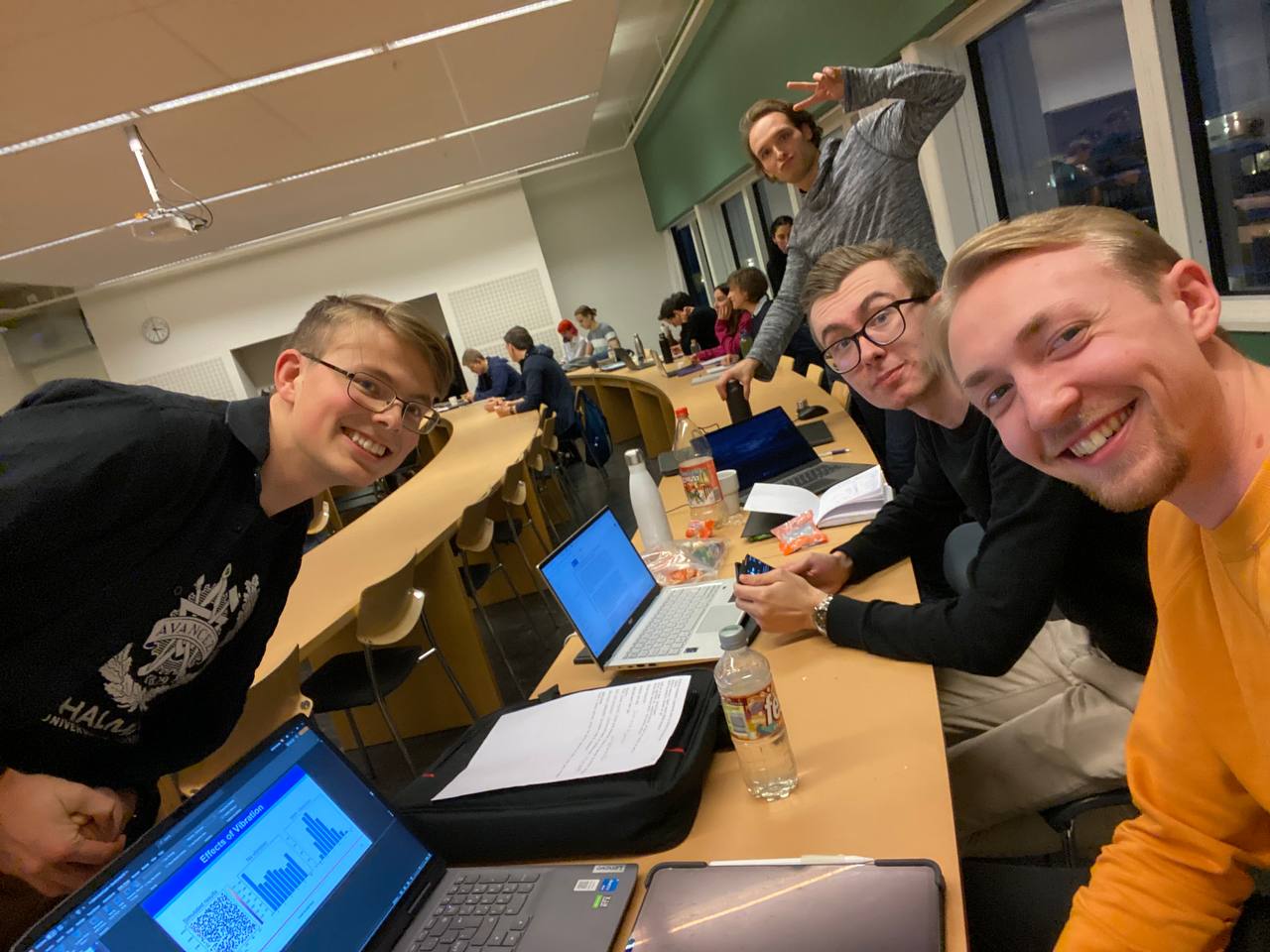
<p><img src="../assets/images/chalmers_Team.jpg" alt="Having a blast while clocking a collective 8 hours of sleep" /></p>

<p>It’s been a pleasure to coach these guys over the past three months and to encourage in-depth discussions over what at first glance may look like <em>simple</em> physics problems. As anyone who has been part of the IPT, they are everything but. Everyone toutes their prowess on second order pertubative many-body quantum field theory until they are asked to quantify the behavior of sand.</p>

<p>It’s been a while since I’ve written in this blog, but the last two years of interfacing with the academic apparatus have more than reinforced my idea about the excess of science instrumentalism. Sometimes science should just be for fun, and the IPT is one such opportunities where the inherent value of the science is at full display.</p>

<p>For the uninitiated, the <a href="iptnet.info">IPT</a> is an international competition for bachelor and masters students in which they work over the course of six months to solve 17 physics problems. Unlike an oylmpiad, however, these problems do not have an a priori exact solution nor a standard method to be solved; thus encouraging the participants to explore a wide range of theoretical, numerical and experimental approaches.</p>

<p>The competition is composed of a series of Physics Fights, in which the students present, critique and review each others work in a process emulating peer review. This is a great opportunity for young scientists to acquire presentation, debating and persuation skills in a scientific context.</p>

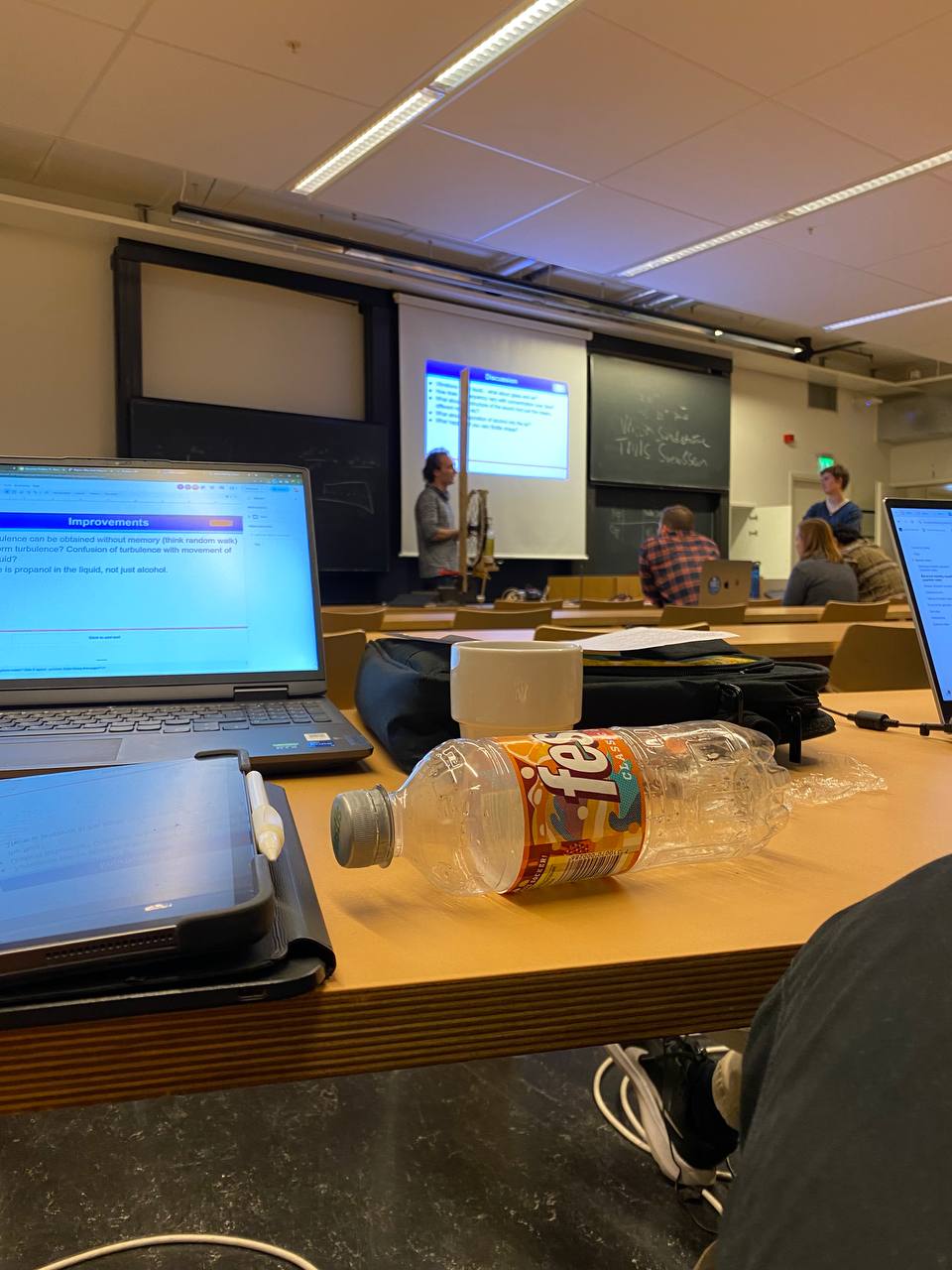
<p><img src="../assets/images/fight_1.jpg" alt="Nils about to smack some serious turbulence" /></p>

<p>Technically, I am their Team Leader, but I prefer the term Team Coach, which better defines my approach to the role. Over the dozens of weekly meetings that I’ve had with these guys, we have discussed the problems, proposed and debated courses of action and came up with solutions for problems accross a wide range of disciplines such as optics, fluid mechanics, statistics, classical mechanics and electromagnetism. Since there is no seniority requirement for the tournament, we have a wide array of students from first year to masters and thus I have had to step in as teacher and give them the tools necessary to advance their solutions as much as possible.</p>

<p>It has been a great opportunity to refine my pedagogical skills and teach in a highly collaborative environment where we are only limited by our creativity and my teaching chops. Something I have found out about teaching physics outside of my solid-state wheelhouse is that I have to re-learn a great deal in order to explain concepts in the easiest way possible and with step-by-step mathematical tools. I have found success with a paradigm that is proving increasingly useful: give them just enough context so they can understand what you are trying to say.</p>

<p>So, we went up to Stockholm to fight for the right to represent Sweden at the International competition. Two fights and four discussion filled rounds later, we walked away with a razor thin point margin and claimed the victory for Chalmers/GU. The KTH guys were good opponents and had some interesting solutions as some of their team members were IPT veterans. Everyone likes an underdog story, so with their 14 students vs our six (four in person, since two couldn’t make it), we had the deck stacked against us. In the end, we prevailed or, more accurately, my guys prevailed.</p>

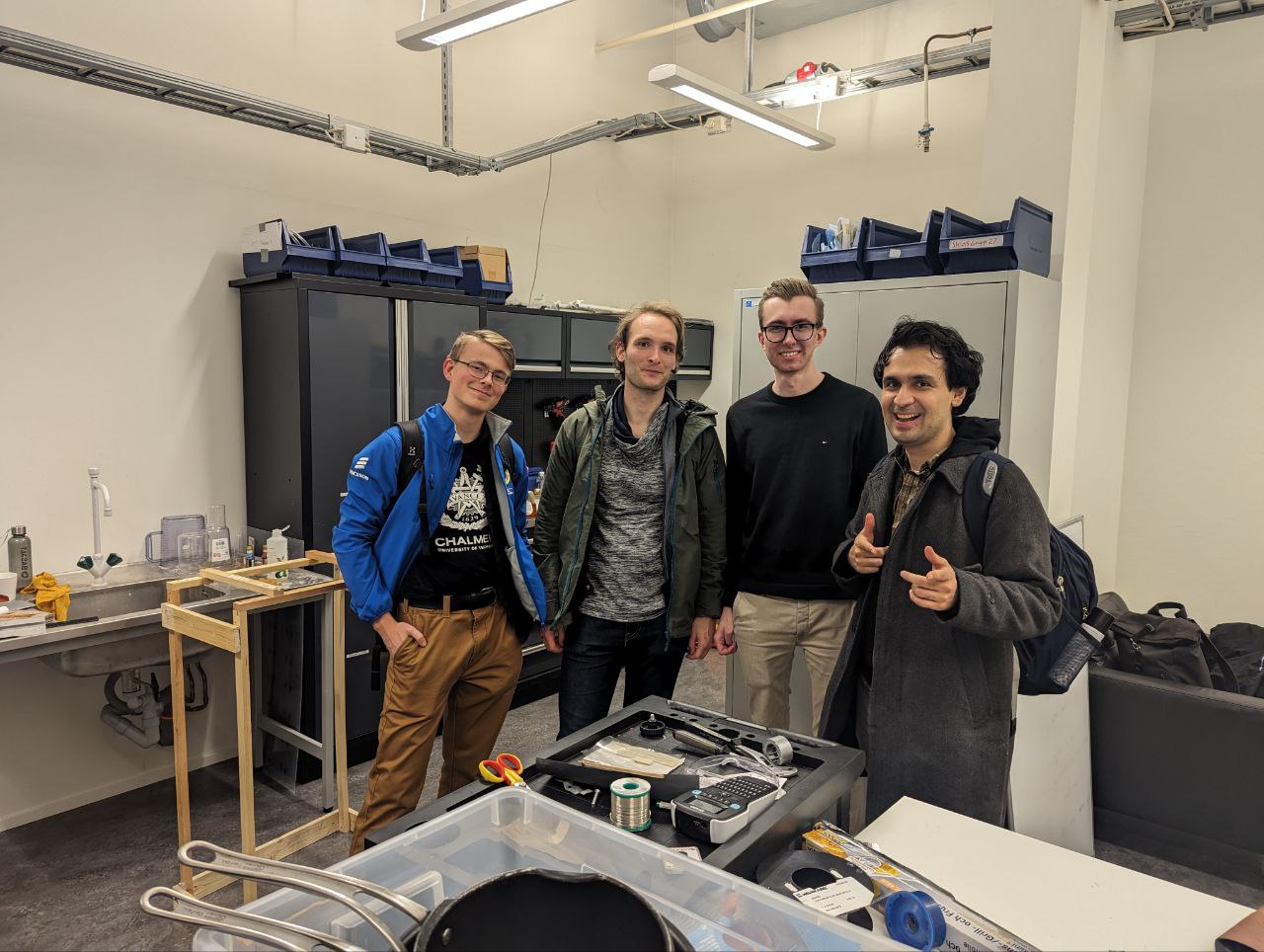
<p>Viktor, Griffin, Erik, Nils (and Marin and Johnathan in absentia) my deepest congratulations and get ready to go to Zurich and kick some serious ass.</p>

<p><img src="../assets/images/winning_faces.jpg" alt="Post victory photo" /></p>]]></content><author><name>Victor H. González</name></author><summary type="html"><![CDATA[After a great performance during today’s Nationals for the International Physicists’ Tournament, the Chalmers Team has kept up tradition and won the right to represent Sweden at the International competition.]]></summary></entry><entry><title type="html">Paper summary: Ultra-Low Current 10 nm Spin Hall Nano-Oscillators</title><link href="https://akravasthewise.github.io/ultra-low-shnos/" rel="alternate" type="text/html" title="Paper summary: Ultra-Low Current 10 nm Spin Hall Nano-Oscillators" /><published>2023-11-21T00:00:00+00:00</published><updated>2023-11-21T00:00:00+00:00</updated><id>https://akravasthewise.github.io/ultra-low-shnos</id><content type="html" xml:base="https://akravasthewise.github.io/ultra-low-shnos/"><![CDATA[<p>In this blog post, I want to share some insights from our paper titled <strong>“Ultra-Low Current 10 nm Spin Hall Nano-Oscillators.”</strong> This research focuses on developing <strong>spin Hall nano-oscillators (SHNOs)</strong> with ultra-low current requirements, scaling their size down to just 10 nanometers while still maintaining efficient operation. These SHNOs have exciting potential applications in neuromorphic computing, oscillator-based Ising machines, and other areas requiring energy-efficient computation.</p>

<h3 id="what-are-spin-hall-nano-oscillators">What Are Spin Hall Nano-Oscillators?</h3>

<p>For those not familiar with SHNOs, they are devices that use <strong>spin-orbit torque (SOT)</strong> to convert electrical currents into microwave oscillations. These oscillations can be used for communication and computational applications. The challenge is that when SHNOs are miniaturized—scaled down to sizes below 50 nm—the threshold current (the amount of current required to start oscillations) often becomes too high for practical use. Our research focuses on overcoming this hurdle by addressing how different substrates and seed layers affect the SHNOs’ performance at very small scales.</p>

<h3 id="key-findings-of-the-paper">Key Findings of the Paper</h3>

<ol>
  <li>
    <p><strong>Scaling Down to 10 nm:</strong>
In this work, we successfully fabricated SHNOs as small as 10 nm wide. By carefully selecting the right combination of materials and substrates, we were able to achieve auto-oscillations at a current as low as <strong>26-30 µA</strong>, which is a significant reduction from previous SHNO designs that required much higher currents. This is a big step forward because reducing power consumption is crucial for building large arrays of SHNOs for real-world applications like <strong>neuromorphic computing</strong> and <strong>Ising machines</strong>.</p>
  </li>
  <li>
    <p><strong>Substrate and Seed Layer Optimization:</strong>
One of the main innovations in this work was optimizing the substrates and seed layers used to grow the SHNOs. We found that using <strong>ultra-thin Al₂O₃ (aluminum oxide) seed layers</strong> on <strong>high-resistance silicon (HiR-Si)</strong> substrates was key to reducing current leakage and improving performance. This combination provided better insulation and allowed us to minimize the current needed to start oscillations.</p>
  </li>
  <li>
    <p><strong>Addressing Heat Dissipation:</strong>
Another critical factor was managing heat dissipation. When working at such small scales, heat can build up and degrade the performance of the SHNOs. Through <strong>COMSOL simulations</strong>, we showed that the Al₂O₃ seed layer not only improved electrical insulation but also enhanced heat dissipation, which helps in maintaining the device’s stability even when scaling down to nanoscopic dimensions.</p>
  </li>
  <li>
    <p><strong>Record Low Threshold Currents:</strong>
The SHNOs we developed operated at <strong>record low threshold currents</strong>—around 26 µA for 10 nm devices. This is more than 20 times better than the previously reported smallest SHNOs at 20 nm, which required significantly more power. This reduction in operational current means we can now think about scaling SHNOs into larger arrays, making them viable for practical computational tasks.</p>
  </li>
  <li>
    <p><strong>Implications for Large SHNO Arrays:</strong>
The research suggests that we could pack up to <strong>1600 SHNOs within an area of less than 1 µm²</strong>, with very low total power consumption (around 1.4 mW). This paves the way for future <strong>large-scale SHNO arrays</strong>, which could be used in applications like <strong>dynamic neural networks</strong> or for <strong>mutual synchronization</strong>, where groups of SHNOs work together to produce more complex oscillation patterns.</p>
  </li>
</ol>

<h3 id="conclusion">Conclusion</h3>

<p>This paper demonstrates that it is possible to scale SHNOs down to <strong>10 nm</strong> while maintaining ultra-low threshold currents, opening the door for <strong>energy-efficient, large-scale spintronic devices</strong>. By carefully choosing the right materials and substrates, we were able to solve some of the key challenges in SHNO miniaturization, including current leakage and heat management. These findings have exciting implications for building <strong>next-generation computing platforms</strong>, from neuromorphic systems to Ising machines, all while keeping power consumption to a minimum.</p>

<p>This breakthrough makes me optimistic about the future of SHNO technology and its role in <strong>energy-efficient, high-performance computing</strong>. Stay tuned for more updates as we continue to push the boundaries of spintronics and explore the full potential of these incredible devices!</p>

<p><a href="https://doi.org/10.1002/adma.202305002">Link to the paper</a></p>]]></content><author><name>Victor H. González</name></author><summary type="html"><![CDATA[In this blog post, I want to share some insights from our paper titled “Ultra-Low Current 10 nm Spin Hall Nano-Oscillators.” This research focuses on developing spin Hall nano-oscillators (SHNOs) with ultra-low current requirements, scaling their size down to just 10 nanometers while still maintaining efficient operation. These SHNOs have exciting potential applications in neuromorphic computing, oscillator-based Ising machines, and other areas requiring energy-efficient computation.]]></summary></entry><entry><title type="html">The IPT is looking for phycisists</title><link href="https://akravasthewise.github.io/IPT-recruiting-2023/" rel="alternate" type="text/html" title="The IPT is looking for phycisists" /><published>2023-09-12T00:00:00+00:00</published><updated>2023-09-12T00:00:00+00:00</updated><id>https://akravasthewise.github.io/IPT-recruiting-2023</id><content type="html" xml:base="https://akravasthewise.github.io/IPT-recruiting-2023/"><![CDATA[<p><img src="../assets/images/physics-hardness-meme.jpg" alt="What they never tell you during undergrad" /></p>

<p>Have you ever wondered how physical models are created? Why are equations formulated the way they are? What do these relationships reveal about everyday phenomena? If these questions intrigue you, the IPT is just for you!</p>
<h1 id="what-is-the-ipt">What is the IPT?</h1>
<p>The International Physicists Tournament, or IPT for short, is a global competition for physics and engineering students. It seeks to hone theoretical and experimental analytical skills through the exploration of 17 open-ended problems. Over a span of six months, participants will design, build, test, and analyze the systems proposed in these challenges, culminating in a presentation at ETH in Zurich the following spring.</p>

<p>IPT’s problems are framed to be easily comprehensible, yet they demand creativity and a robust grasp of physics for resolution. An added perk? You earn credits that can be applied toward your engineering physics or physics degree. Check out our syllabus <a href="../assets/IPT_course_syllabus.pdf">right here</a>.</p>

<p><a href="https://www.youtube.com/watch?v=kD28edrq_dY"><img src="https://img.youtube.com/vi/kD28edrq_dY/0.jpg" alt="IPT Chalmers team from 2023" /></a></p>
<h2 id="a-sample-ipt-problem">A sample IPT problem</h2>
<p><strong>Smart water</strong></p>

<p>If you let water flow in a maze you end up with a physical maze-solving algorithm. Many other algorithms and computations can be done with physical systems. Create a water-based computer (without electronics) that solves an NP-hard problem.
<a href="https://www.youtube.com/watch?v=81ebWToAnvA"><img src="https://img.youtube.com/vi/81ebWToAnvA/0.jpg" alt="Smart water" /></a></p>

<h1 id="what-do-i-need-to-know">What do I need to know?</h1>

<p>As a general requirement, you should be a bachelors or masters student at Chalmers or GU accepted to a physics or engineering program. That said, feel free to apply if you are enthusiastic about the tournament and think you can bring another perspective to the table.</p>

<p>No specific seniority or prior experience is mandated—you’ll gain ample knowledge as you delve deep into the problems. If physics excites you and you’re keen on acquainting yourself with the methodologies and cognitive processes characteristic of scientists, I’m here to guide you through any required concepts.</p>

<h1 id="how-do-i-apply">How do I apply?</h1>

<p>In order to apply, you must send me a short pre-study report on one of the problems of the <a href="https://iptnet.info/wp-content/uploads/2023/09/problem-list24.pdf">IPT 2024 list</a>. You can choose between the following:</p>
<ul>
  <li>Galton Board</li>
  <li>Jumpy hoop</li>
  <li>Salty shapes</li>
  <li>Alcohol soundcheck</li>
  <li>Bubbles under a wet glass</li>
</ul>

<p>In your report, outline your initial reactions to the problem. Pose these questions: How would you go about it? Are there relevant equations or principles to consider? Can you conceive an experimental setup to systematically change the variables of the phenomenon??</p>

<p><strong>Deadline:</strong> The report must be written in english and <a href="mailto:vhgonzalezsa@gmail.com">emailed to me</a> in pdf format by <strong>Wednesday September 27th at 23:59</strong></p>]]></content><author><name>Victor H. González</name></author><summary type="html"><![CDATA[]]></summary></entry></feed>